































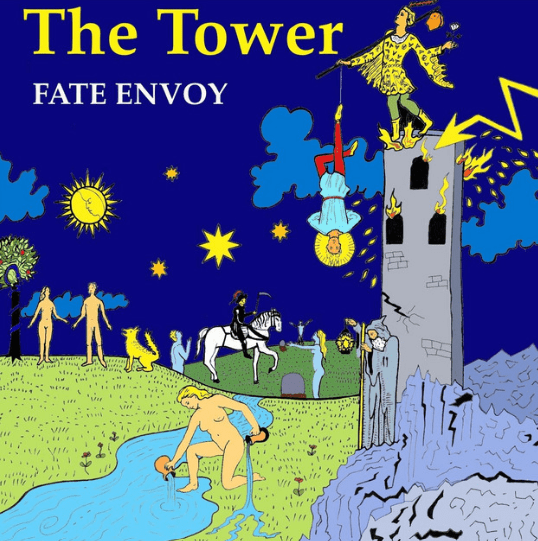
There is something wonderfully ambitious about a debut that arrives already knowing exactly what it wants to explore. Fate Envoy’s The Tower takes nine songs and threads them through the Major Arcana of the Tarot, transforming a guitar-driven alternative-rock record into a story about crisis, perspective, destruction, solitude and connection. The clever twist is that the band did not write the songs to match the cards. They discovered the connections afterwards, turning the Tarot into something closer to a hidden blueprint than a gimmick.
The album consequently feels like a journey with an emotional logic of its own. “Unforeseen Circumstances” opens as The Moon, immediately establishing a world of uncertainty and disorientation. “Lightning” follows as The Hanged Man, while “Sonny’s Party” embraces the reckless spirit of The Fool. These are not simply titles attached to songs for aesthetic effect. Fate Envoy have built a sequence in which each archetype represents another stage in the record’s larger emotional argument.
The sound is equally restless. Eric Anderson and Ari Bayvertyan’s guitars and vocals sit at the centre of a palette that pulls from indie rock, pop-punk, atmospheric alternative and heavier guitar music. The Strokes and Arctic Monkeys provide one point of reference, while Radiohead, System of a Down and Interpol suggest the wider territory Fate Envoy are interested in. It makes sense that the band resist a neat genre label. The Tower seems more interested in emotional momentum than stylistic purity.
That momentum reaches its most dramatic point with “Grandfather,” “The Tower” and “War Is Hell.” Judgement brings ancestry and memory into the picture before the title track blows apart established structures. Then Death arrives not as literal annihilation but as a necessary ending. It is a surprisingly mature idea for a debut, particularly because Fate Envoy refuse to frame destruction as the final destination. The album understands that collapse can be painful while still being transformative.
The second half therefore changes the emotional temperature. “I Can Barely Talk” enters the solitude of The Hermit, before “A Moment In Eternity” reaches toward The Star and its promise of restoration. Then comes “This Dance,” representing The Lovers. There is no tidy fairytale resolution here. Instead, connection becomes an act of choice. After everything has fallen away, remaining open to another person becomes its own form of courage.
That philosophy also explains why The Tower feels bigger than its 35-minute runtime. Fate Envoy have created a companion Reading, complete with essays, lyric analysis and a closing rite for each song, while every track receives its own original Tarot card. Behind it all is a band building its world from the ground up, literally constructing its own recording studio and shaping the album themselves. The Tower is an ambitious introduction, but its greatest strength is that the ambition serves something human: the possibility that after breaking down, we can still choose what comes next.
Find Fate Envoy: Instagram, Facebook, Spotify
PR: Danielle Holian, Decent Music PR
Related Stories
Inside Kevin Anglade’s THE BLACK BOX: Music, Identity and Resistance
Kevin Anglade explores social expectations and systemic oppression on THE BLACK BOX, connecting a 14-track album with BRANDED...

JUILS left Nashville for London and wrote the words she almost said
On her second EP 'What I Meant to Say', the Boston-born, London-based songwriter turns her first year in...

‘Skeletor Bag’ Brings mars kumari, Del the Funky Homosapien and an Underground Cast Together
Inside Skeletor Bag, the seven-track collaboration from mars kumari and Del the Funky Homosapien featuring Jel, doseone, Fatboi...