






























For Blackheartstar, music was never a pastime. It became a necessity during his teenage years, sparked by the first encounters with artists like Nine Inch Nails and Marilyn Manson. What began as lyric writing to process inner turmoil slowly evolved into a creative framework for survival. Those early words were not written with structure or audience in mind. They were maps, drawn to make sense of a restless and crowded inner world. That instinct still anchors his work today, even as the sound around it has grown far more expansive.
That foundation explains why Blackheartstar refuses to live inside a single genre. His music moves deliberately between symphonic metal, industrial, cinematic scoring, and even dark western country. Rather than reinventing themes, he recontextualizes them. A single narrative can feel suffocating in one arrangement, then vast and cinematic in another. The density of his production is intentional, designed to immerse the listener fully rather than leave emotional space unexamined. Every sound serves the story.
Choosing this inward-facing creative path has come at a cost. Growth has been slow by design, as Blackheartstar avoids the constant churn of social media promotion. The trade-off is freedom. Without external pressure, the work stays uncompromised. That choice has been validated in moments where the music reached beyond his core audience, particularly with tracks like The Final Key of Solomon (Mind Version) and Seals of Light (Heaven Version). Those responses confirmed that the work could connect on its own terms.
Connection, for him, remains personal. When listeners reach out, he answers. Conversations often unfold with fellow artists who recognize the intention behind the complexity. That small but aligned audience reflects the advice he would give his younger self: start without fear, and protect the instinct that tells you what feels true before the noise of opinion sets in.
Creatively, Blackheartstar is currently refracting his ideas rather than abandoning them. After completing I’m Sick: Mania, he began exploring its themes through alternate perspectives. The same emotional core appears as a 1990s pop-inspired experiment on Manic, then reemerges as a psychedelic western on Psychosis. The goal is not novelty, but clarity. Each version reveals a different emotional truth.
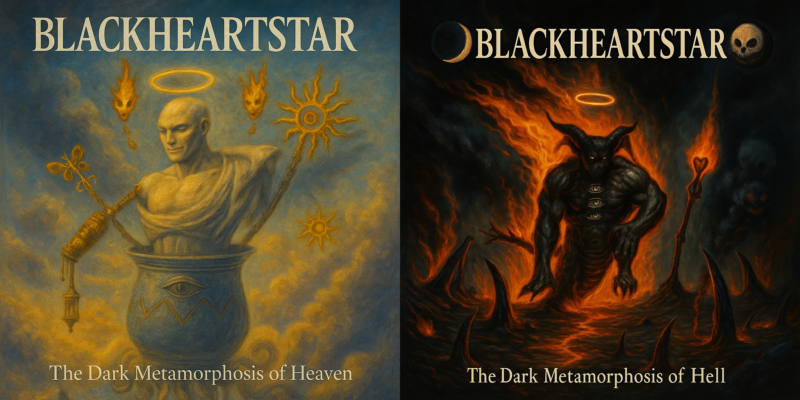
Looking ahead, his focus turns back to where it all began. He plans to revisit The Dark Metamorphosis, rebuilding it with the original lyrics he wrote at sixteen, untouched by revision or hindsight. It is an act of honesty, not nostalgia. For Blackheartstar, progress is not linear. It is a continual return to the source, proving that the darkest ideas, when examined closely, can still reveal something vital and alive.
Related Stories

See Your Shadow Gives “Weekend” a Country-Rock Second Life
See Your Shadow reinvents “Weekend (Can't Get Here Soon Enough)” as a live-inspired country-rock single, arriving October 30...

Ananda Xenia Shakti Brings Her Punk Spirit to “A Revolution in Love”
Ananda Xenia Shakti brings punk history, spoken-word reflection and deep house together on “A Revolution in Love,” arriving...
Cashus King Finds Room to Experiment Over M.Waisome’s Atmospheric Beats in ‘The Greatest Album Never Heard’
Cashus King and producer M.Waisome combine lyrical precision with expansive, soul-infused production on The Greatest Album Never Heard,...